Introduction
I’m a simple man, and when I see “simple” stunts like the one I belive was just pulled I get pissed off. As you can see in Kollewe and Wearden (2026) Trump made a nice little killing on the recent, imho, market manipulation. Trump, apparently, made up to $15m on Nvidia stock after Huang’s return.
How we got here
The short version is that Jensen Huang resigned as Nvidia’s CEO on November 12 and was back in the job eleven days later (Wikipedia contributors 2026). Here is the whole thing on one page (Figure 1).
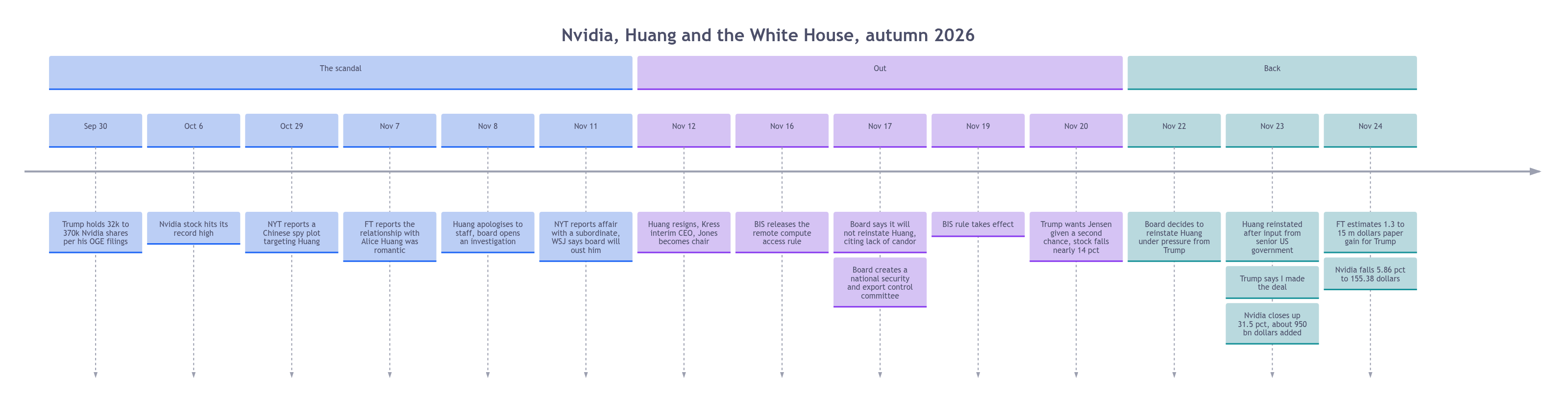
The long version starts with Alice Huang (no relation I hope), an executive at the Singapore data centre company Megaspeed International. US investigators say Megaspeed got hold of around 240,000 chips that are banned from export to China and is under investigation in the US and Singapore for smuggling them there. US intelligence suspects Alice Huang of spying for China (Sundby 2026). On October 29 the New York Times reported a Chinese spy plot targeting Jensen. On November 7 the Financial Times reported that US officials believed the relationship was romantic, and the next day he apologised to Nvidia’s employees for being unfaithful. On November 11 the New York Times, citing five employees, reported that he’d also had a relationship with Kimberly Powell, a vice president who reported to him, and the Wall Street Journal reported that the board was preparing to remove him (Sundby 2026; Wikipedia contributors 2026).
The board accepted his resignation that day. The 8-K filed on November 12 says he resigned as President, CEO and director “effective immediately”, that CFO Colette Kress becomes interim CEO, and that Harvey C. Jones becomes the company’s first ever Chair of the Board (NVIDIA Corporation 2026a). On November 17 Jones told the earnings call that the board “does not intend to reinstate” him and cited a “lack of candor” (Wikipedia contributors 2026).
What the market did
Badly. Nvidia closed at $166.19 on the day of the resignation (Sundby 2026). On November 20, the day Trump said he’d “love to see Jensen be given a second chance”, it fell nearly 14%, and the company had by then lost about $2.7 trillion in market value since its October 6 peak (Wikipedia contributors 2026). The S&P 500 fell more than 9% between November 12 and November 20, and the Dow, S&P 500 and Nasdaq all ended that Friday in correction territory (Giangiulio 2026).
Goldman Sachs’ traders put it well: “Not sure yet whether good or bad that the fate of the market is almost equal to the fate of one person” (Giangiulio 2026). That’s what concentration looks like. As I wrote in Who’s paying for all of this?, the ten largest stocks are now almost 40 percent of the S&P 500, so if you own a plain index fund or have a pension, you own this ride whether you wanted to or not. When the whole index falls 9% in the week after one CEO resigns, it’s your retirement savings that take the hit.
“I made the deal” he said
Trump also posted on Truth (yeah right) Social that “The Country needs Jensen’s leadership at Nvidia” (Hutchinson 2026). Bloomberg reported that the board made its decision on the afternoon of November 22 under pressure from Trump, and without consulting the interim CEO (Wikipedia contributors 2026).
On Monday, November 23, Nvidia filed another 8-K. The board voted unanimously to reinstate Huang as President, CEO and director. The filing says, and I’m quoting it, that “the Board received input from senior levels of the United States government” and “is confident that Mr. Huang’s reinstatement poses no national security risk”. The investigation into Huang continues, and the board has set up a National Security and Export Control Committee of independent directors (NVIDIA Corporation 2026b).
Trump was happy to take the credit. He told CNBC:
“I spoke to them. Let me put it this way: And I convinced them. I made the deal.”
And on national security (Hutchinson 2026):
“They did ask for assurance on the national security threat, and we gave them assurance”
Nvidia closed up 31.5% that day. That’s about $950 billion of market value, the largest one-day gain in market history. The S&P 500 rose 4.7% and the Nasdaq 100 almost 7% (Kopack 2026). Nvidia closed at $165.05 (Tao 2026), which is roughly where it closed on the day Huang resigned. It is still about 30% below its October 6 record (Kopack 2026). The next day, November 24, it gave some of that back. It fell 5.86% to close at $155.38, about $240 billion of market value (Fulton 2026).
Who got paid
Trump owns Nvidia stock, and it isn’t in a blind trust (Noah 2026). According to the Financial Times, his filings to the Office of Government Ethics, made on November 5, suggest he held between 32,000 and 370,000 Nvidia shares on September 30. The rally on November 23 would then have added between $1.3 million and $15 million to their value (Sheth 2026). A BBC review of his disclosures over the past two years found Nvidia purchases worth between $23 million and $86 million, and sales with gains of $3.5 million to $10.2 million (Kollewe and Wearden 2026).
The filings are in broad dollar bands, so nobody knows the exact number. And they stop at September 30, so we don’t yet know whether anything was bought or sold in October or November (Sheth 2026). The White House says independent advisers handle the trades without Trump’s input (Noah 2026). Senator Ruben Gallego’s response was “We need to investigate what stock positions took place before the announcement” (Kollewe and Wearden 2026).
The bigger story is who gets compute
The stock and Trump’s portfolio are what people are talking about. I think the more important thing happened in the same week, and it’s about who gets to use these chips at all.
On November 16, while Huang was out, the Commerce Department’s Bureau of Industry and Security released an interim final rule on remote access to advanced chips. BIS itself says the rule was “written by and at the direction of the Department of Treasury and the National Security Council” (Bureau of Industry and Security 2026), and Politico reported that Treasury Secretary Scott Bessent pushed it through over objections from Commerce (Politico 2026). It took effect on November 19 with no compliance period (Stafford Powell et al. 2026).
Here’s what it does (Stafford Powell et al. 2026):
- You need a licence to ship advanced chips to any data centre, anywhere in the world, that provides more than 12 million “aggregate TPP” of compute to companies headquartered in China, Macau or another Country Group D:5 destination. Linked data centres count together.
- Suppliers must get know-your-customer information from the data centre. A data centre that won’t or can’t provide it is a red flag that presumptively counts as “knowledge” of a prohibited end use.
- Indonesia, Malaysia, Singapore, Thailand and Brazil now need a licence for advanced chips at all. The exception is where the end user is headquartered in the US, provided it files monthly reports.
- The rule formally rescinds Biden’s AI Diffusion Rule, including the controls on model weights.
- The rule now calls these chips “Super Intelligence” items rather than “Artificial Intelligence”, following Executive Order 14434.
Then look at what Nvidia agreed to when it took Huang back. Its board now has a National Security and Export Control Committee to “oversee trade compliance and national security risks”, and it took Huang back after “input from senior levels of the United States government” (NVIDIA Corporation 2026b).
Put those together. The world’s dominant supplier of AI compute now has a government-facing compliance committee on its board, and a CEO who owes his job to the president. Customers have to know who is using every large cluster and report it. Five more countries now need permission to buy, unless the buyer is American. Every one of those steps can be defended as stopping chips from being smuggled to China, and some of it surely is. But the effect is that access to compute, which is what intelligence now runs on, is decided more and more by a small number of people in Washington and Santa Clara. Whoever controls compute in the long run controls who gets to build and use machine intelligence, and right now that control is being concentrated, not spread.